%20(1).png)
Angus Tsui and the Future of Fashion: Why 404: Safety Not Found Feels Like a Warning for the Digital Age
- hace 16 horas
- 4 min de lectura
Fashion has always reflected the anxieties of its time.
In the 1980s, designers explored excess and power. The 1990s brought minimalism and introspection. The early twenty-first century became obsessed with speed, technology and globalization.
Today, however, a different concern dominates cultural conversations.
Visibility.
We live in an era where every moment can be documented, every opinion can be amplified and every individual is expected to exist in a permanent state of exposure. Social media has transformed the relationship between public and private life, creating a world in which being seen is often treated as a necessity rather than a choice.
Few designers have explored that tension as vividly as Angus Tsui.
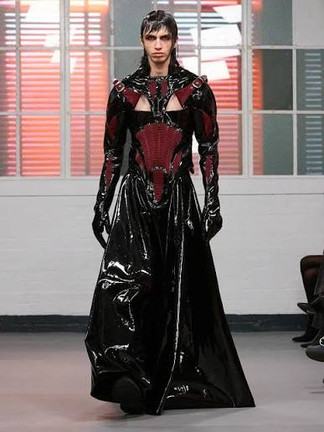
With his Autumn/Winter 2026 collection, 404: Safety Not Found, the Hong Kong designer presented one of the most visually arresting collections of the season, transforming digital anxiety into a dystopian fashion narrative that felt simultaneously futuristic and deeply human. Presented on the official schedule of London Fashion Week, the collection marked a significant milestone for a designer who has spent more than a decade building one of Asia's most distinctive independent fashion voices.
Building a Universe Beyond Trends
Unlike many emerging designers who focus on individual collections, Angus Tsui has spent years constructing an entire universe.
His work sits at the intersection of science fiction, sustainability, technology and speculative design. Biomechanical silhouettes, futuristic structures and experimental materials have become recurring elements throughout his collections, creating an aesthetic language that feels instantly recognizable.
Yet beneath the dramatic visual presentation lies a surprisingly consistent philosophy.
Since launching his label in 2014, Tsui has championed sustainable design practices, upcycling initiatives and environmental responsibility without sacrificing creativity or ambition. His work demonstrates that sustainability does not need to look minimal or conventional. It can be provocative, theatrical and emotionally charged.
That balance between imagination and responsibility has become one of the defining characteristics of the brand.
When Fashion Mirrors Digital Anxiety
The title 404: Safety Not Found immediately evokes the language of the internet.
A familiar error message becomes a metaphor for modern existence.
According to Tsui, the collection explores feelings of exposure, restraint and the search for authenticity in an increasingly connected world. Rather than presenting technology as a source of liberation, the collection examines the vulnerability that often accompanies permanent visibility.
This theme resonated throughout the runway.
The garments appeared almost defensive, as though designed for bodies attempting to protect themselves from external intrusion. Sculptural constructions wrapped around the torso, exaggerated silhouettes disrupted traditional proportions and sharply defined surfaces created a sense of tension between protection and exposure.
It was not difficult to imagine these looks existing within a dystopian future.
The more unsettling realization was how closely that future resembled the present.
Horror, Sci-Fi and the Language of Transformation
One of the most fascinating aspects of Angus Tsui's work is his ability to translate cinematic influences into fashion without reducing them to costume.
Observers immediately noted references to science fiction and horror cinema throughout the collection. Elements reminiscent of biomechanical creatures, dystopian worlds and dark futuristic mythology appeared throughout the runway presentation. Several fashion commentators drew parallels with the visual language of Hellraiser and the broader tradition of body horror, while Tsui himself has long embraced influences ranging from Alien to speculative futurism.
What makes these references compelling is their purpose.
They are not nostalgic tributes.
They function as visual metaphors.
The distorted forms, exposed structures and hybrid silhouettes reflect contemporary fears surrounding identity, surveillance and digital existence. Fashion becomes a vehicle for exploring questions that increasingly define modern life.
Who are we when everything is visible?
What remains private?
And what happens when the boundaries between reality and performance begin to disappear?
Sustainability Without Compromise
For many designers, sustainability exists as a supporting message.
For Angus Tsui, it forms part of the creative foundation.
Throughout his career, the designer has explored upcycling, circular design and material innovation, demonstrating that responsible production can coexist with avant-garde aesthetics. His ANCares initiative and various collaborative projects have reinforced this commitment, positioning him among the most visible advocates for sustainable fashion within Hong Kong's design community.




What makes this approach particularly interesting is that Tsui refuses the visual clichés often associated with sustainable fashion.
His collections do not ask consumers to choose between ethics and creativity.
They argue that the future of fashion requires both.
Why K-Pop Fans Should Be Paying Attention
While Angus Tsui has spent years cultivating a dedicated following within fashion circles, recent visibility from the world of K-Pop could introduce his work to an entirely new audience.
That possibility became especially relevant after fans noticed Bang Chan of Stray Kids wearing multiple Angus Tsui designs in recent music video "Run It"
The connection feels surprisingly natural.
Much like Tsui's collections, Stray Kids have built their identity around experimentation, self-expression and a willingness to challenge expectations. Bang Chan's personal style frequently moves between luxury fashion, streetwear and conceptual design, making him an ideal figure to introduce audiences to independent designers operating outside the traditional luxury system.
For emerging labels, this kind of visibility can be transformative.
The influence of K-Pop on global fashion has become impossible to ignore. Artists no longer simply wear clothing; they actively shape consumer interest, drive cultural conversations and introduce new generations to designers they may never have encountered otherwise.
If more fans begin exploring Angus Tsui's work through Bang Chan, they will discover a designer whose vision extends far beyond a single collection.
Fashion's Parallel Universe
Angus Tsui once described his designs as "wormholes to parallel universes." That description feels particularly appropriate when examining 404: Safety Not Found.
The collection does not merely present clothing.
It presents possibilities.
It imagines worlds shaped by technological dependence, emotional vulnerability and the increasingly blurred boundaries between digital and physical existence.
Yet despite its futuristic appearance, the collection ultimately speaks about something timeless.
The desire to remain authentic in environments that constantly encourage performance.
The struggle to maintain individuality within systems designed around visibility.
The search for humanity in a world increasingly mediated by screens.
These are not concerns limited to fashion.
They are among the defining questions of contemporary life.
And in 404: Safety Not Found, Angus Tsui transformed them into one of the most thought-provoking collections of the season.