%20(1).png)
The Colour Combinations Luxury Fashion Loves , And Why They Work
- hace 2 días
- 4 min de lectura
Fashion has always been obsessed with colour.
Not simply because colour attracts attention, but because it communicates emotion before a silhouette, fabric or logo has the chance to speak.
A black coat can feel powerful, a cream coat can feel refined.
Yet place either beside the right colour and the entire story changes.
This is something luxury fashion has understood for decades. The most elegant wardrobes are rarely built around trend colours alone. Instead, they rely on carefully balanced palettes that create harmony, depth and visual confidence.
The secret is not necessarily choosing beautiful colours.
It is choosing beautiful combinations.
Why Some Colour Pairings Feel More Expensive Than Others
Luxury is often associated with craftsmanship, tailoring and materials, but colour plays an equally important role.
Designers and stylists frequently rely on principles of colour theory to create visual balance. Complementary colours generate contrast and energy, while analogous colours create harmony and sophistication. In both cases, success depends less on the colours themselves and more on how they interact with one another.
The most successful palettes rarely feel accidental.
They feel intentional.
That is often the difference between a memorable outfit and a forgettable one.
Navy and Camel: The Quiet Luxury Uniform
Few combinations embody modern luxury more effectively than navy and camel.
At first glance, the pairing appears remarkably simple. Navy provides structure and depth, while camel introduces warmth and softness. Together they create a balance that feels sophisticated without ever appearing overly formal.
It is no coincidence that luxury brands frequently return to this palette season after season. The combination offers all the elegance of black and beige, yet feels richer, more contemporary and considerably less predictable.
A camel coat worn over navy tailoring remains one of fashion's most reliable expressions of understated elegance.
Burgundy and Cream: Richness Without Excess
Burgundy has experienced a remarkable resurgence in recent years.
Part of its appeal lies in its versatility. Deep enough to function almost as a neutral, yet distinctive enough to create visual interest, burgundy occupies a unique place within fashion's colour landscape.
When paired with cream, its richness becomes even more apparent.
The contrast feels soft rather than dramatic. Luxurious rather than flashy.
It is a combination that evokes heritage, craftsmanship and timeless style, which perhaps explains why variations of this palette continue to appear in both ready-to-wear collections and luxury accessories.
Olive Green and Burgundy: The Colour Theory Favourite
Some of fashion's most successful colour combinations emerge directly from colour theory.
Olive green and burgundy are a perfect example.
The pairing works because both colours are muted versions of complementary hues. The result is contrast without aggression, visual interest without chaos.
Fashion enthusiasts often gravitate toward this combination because it feels distinctive while remaining remarkably wearable. It has depth, maturity and a certain intellectual quality that distinguishes it from more obvious pairings.
It is also a combination that photographs exceptionally well, which explains its enduring popularity in editorial fashion.
Chocolate Brown and Powder Blue: Soft Contrast
Not every sophisticated colour palette relies on dark tones.
Chocolate brown and powder blue demonstrate how contrast can be achieved through temperature rather than intensity.
Brown brings warmth and stability.
Blue introduces freshness and calm.
Together they create a balance that feels effortless and modern.
Luxury fashion's renewed interest in brown over the past few years has made this combination particularly relevant. As designers increasingly move beyond black as the default neutral, brown has emerged as one of the most versatile foundations for contemporary dressing.
Charcoal and Ivory: Minimalism at Its Best
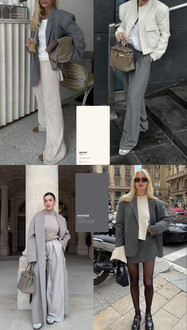
If there is a colour combination that perfectly captures the essence of modern minimalism, it is charcoal and ivory.
The palette relies on subtle contrast rather than dramatic opposition.
Ivory softens charcoal's severity.
Charcoal gives ivory structure and definition.
The result feels architectural, refined and timeless.
Many of the world's most respected minimalist brands have built entire visual identities around variations of this principle. It proves that sophistication does not always require complexity. Sometimes restraint is the most powerful statement of all.


Why Fashion Rarely Uses Pure Colour Theory
One of the biggest misconceptions about colour theory is that designers simply pair colours directly opposite each other on the colour wheel.
In reality, fashion tends to favour muted, softened or deepened versions of complementary colours.
A bright red paired with a bright green risks looking festive.
Burgundy paired with olive green feels luxurious.
A vivid orange paired with electric blue can appear overwhelming.
Navy paired with rust feels considered and elegant.
The difference lies in saturation.
Harmony is often created not by reducing contrast, but by controlling intensity. Researchers studying colour harmony have repeatedly found that successful palettes typically combine colour-wheel principles with moderate saturation and carefully balanced tonal values.
The Future of Colour in Fashion
For much of the last decade, fashion was dominated by minimalism, neutrals and the rise of quiet luxury.
Yet recent seasons have revealed a growing appetite for colour.
Not necessarily louder colour.
Smarter colour. Designers are increasingly exploring unexpected combinations that move beyond traditional black-and-white dressing while maintaining a sense of sophistication. From navy and camel to olive and burgundy, the focus has shifted toward palettes that feel personal, distinctive and emotionally resonant. The most stylish wardrobes are rarely defined by individual colours.
Because in fashion, colour is never just colour.
It is language.


