%20(1).png)
IRIS VAN HERPEN: How Haute Couture Became Futuristic Sculpture
- 13 may
- 6 min de lectura
Actualizado: 27 may
3D printing, living biomaterials, alien silhouettes, Met Gala legends and the designer who made fashion look like it came from another dimension
There are designers who follow trends.
There are designers who define eras.
And then there is Iris van Herpen , a designer so radically ahead of the industry that her work often feels less like fashion and more like speculative biology, architecture or science fiction.
For nearly two decades, the Dutch couturière has transformed haute couture into something entirely different:
kinetic sculpture
wearable anatomy
digital craftsmanship
fluid engineering
Long before luxury brands began experimenting with artificial intelligence, 3D printing or “future fashion,” Iris van Herpen was already building garments that looked impossible to construct by human hands.
And yet paradoxically:around 80% of her work is still handmade.
That contradiction defines her entire universe.
The begining: Obsessed with movement
Born in 1984 in Wamel, Netherlands, Iris van Herpen grew up surrounded by nature, dance and craftsmanship.
One of the most formative moments of her childhood came in her grandmother’s attic, where she discovered antique garments and historical costumes that would later influence her fascination with:
transformation
anatomy
historical silhouettes
physical movement
Van Herpen also trained in classical ballet — something that permanently shaped her understanding of the body.
Unlike many designers who begin with sketches, she became obsessed with:
movement before shape
structure before decoration
material before trend
This philosophy would later become central to her couture.
The McQueen Connection
Before founding her own maison, Van Herpen interned at the London studio of Alexander McQueen.
The influence is impossible to ignore.
Like McQueen, she approached fashion as:
emotional performance
conceptual storytelling
wearable art
But while McQueen looked toward:
darkness
history
theatre
Van Herpen looked toward:
science
biology
physics
futurism
She later also worked with Dutch textile artist Claudy Jongstra before launching her own label in 2007.
That same year, she debuted her first collection:
Chemical Crows
Presented during Amsterdam Fashion Week.
Even then, critics immediately noticed something unusual:her garments did not behave like normal couture.
They moved like organisms.
She Changed Fashion Technology Forever
The year 2010 became the turning point.
Van Herpen introduced one of the first true 3D-printed garments ever seen in haute couture with her Crystallization collection.
At the time, the fashion industry barely understood:
digital fabrication
computational design
parametric structures
Most luxury houses still relied almost entirely on traditional tailoring.
Van Herpen instead collaborated with architects, scientists, engineers and Materialise (Belgian 3D-printing company).
The garments became so groundbreaking that one of the pieces was later named among Time Magazine’s best inventions.
Suddenly, haute couture no longer looked historical.
It looked post-human.
The biggest misconception about Iris van Herpen is that her work is “just technology.”
In reality:technology is only the skeleton.
The soul of her work remains deeply artisanal.
Many garments involve:
hand embroidery
laser cutting
individually assembled components
microscopic hand stitching
sculptural draping
Van Herpen herself has repeatedly emphasized that most of her garments are handmade.
One of her most famous Fall 2017 couture pieces, for example:
looked entirely machine-generated
but was actually created by hand manipulating laser-cut metal domes layered over silk tulle.
This tension between: machine and hand/ nature and technology /science and emotion
is exactly what makes her work so extraordinary.
The Most Iconic Collections
CRYSTALLIZATION (2010)
The collection that changed fashion history.
Inspired by:
water structures
liquid transformation
crystallized motion
This was the collection where she introduced 3D printing into couture.
The dresses looked:
frozen mid-motion
almost digitally generated
structurally impossible
Fashion had never seen anything similar.
VOLTAGE (2013)
One of her most scientifically ambitious collections.
Inspired by:
electricity
magnetic fields
energy flow
Van Herpen used:
magnetic resin
acrylic structures
electrically inspired patterning
The collection explored how invisible forces could shape the body itself.
MAGNETIC MOTION
After visiting CERN and studying particle physics, Van Herpen created garments inspired by:
subatomic movement
invisible energy systems
molecular transformation
Some shoes from the collection even incorporated magnets and resin structures.
This was couture operating closer to experimental science than traditional fashion.
SENSORY SEAS
One of her most environmentally focused collections.
Themes included:
ocean pollution
marine ecosystems
climate awareness
Several garments used:
recycled ocean plastics
fluid marine-inspired structures
The collection became especially praised online for combining environmental messaging with couture-level craftsmanship.
TRANSMOTION (2020)
Created during the pandemic era.
Inspired by:
optical illusion
Dutch artist M.C. Escher
distorted movement
Presented partly through film rather than traditional runway format.
The garments appeared almost holographic in movement.
The materials
No contemporary designer experiments with materials quite like Iris van Herpen.
Over the years, she has worked with:
silicone
acrylic
resin
metal mesh
laser-cut polyamide
magnetic particles
biomaterials
flexible 3D-printed polymers
microscopic layering techniques
Some dresses require:
hundreds of hours of hand assembly
computational modelling
custom-built fabrication techniques
One 2024 3D-printed wedding dress reportedly required:
nearly a month of work
600 hours of craftsmanship
41 hours of printing alone.
The Celebrities Who Turned Her Into A Legend
Unlike many couture designers, Iris van Herpen’s clients are not simply celebrities.
They are performers who understand spectacle.

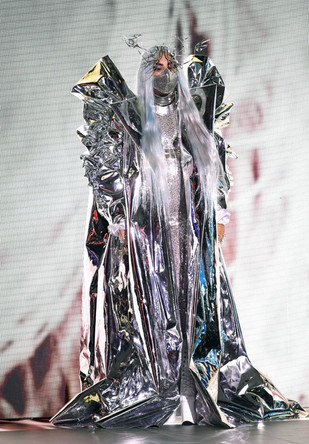



LADY GAGA
One of Van Herpen’s earliest celebrity supporters.
Since 2009, Gaga has repeatedly worn her work.
One of the most famous examples:the black acrylic laser-cut dress created for the launch of Gaga’s Fame perfume in 2012.
The garment looked:
biomechanical
sharp
almost liquid in structure
It helped establish Van Herpen globally.
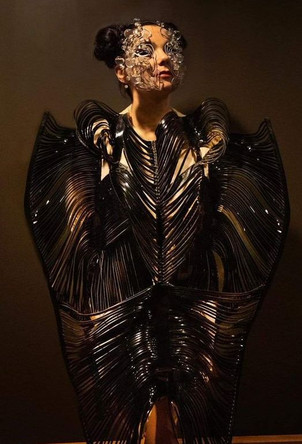
BJÖRK
If Gaga represented futurism,Björk represented organic experimentation.
Van Herpen’s relationship with Björk became one of fashion’s most artistically aligned collaborations.
Their shared fascination with:
nature
mutation
sound
fluidity
made the partnership feel inevitable.
BEYONCÉ
Van Herpen’s work gained mainstream visibility through Beyoncé performances and editorials.
Her sculptural silhouettes amplified Beyoncé’s stage presence by transforming the body into architectural form.
Grimes & The Met Gala
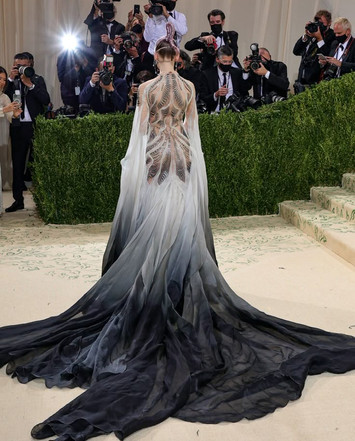
The 2021 Met Gala produced one of the most viral Iris van Herpen moments ever:
Grimes wearing the now-iconic “Bene Gesserit” inspired gown.
The look resembled:
futuristic priestess armor
sci-fi royalty
biomechanical couture


Lisa At Coachella: The New Generation Of Iris Van Herpen
One of the most talked-about recent moments came when Lisa wore custom Iris van Herpen during Anyma’s Coachella set in 2026.
The custom “Omen” gown reportedly required:
over 500 hours of work
seven artisans
metallic-coated leatherette
laser-cut looping techniques
invisible tulle hand-stitching


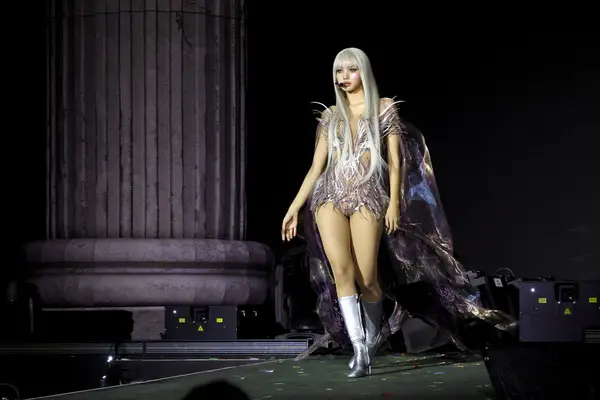
The final result resembled:
cybernetic wings
skeletal armor
digital feathers in motion
The collaboration mattered because it introduced Iris van Herpen to:
younger global audiences
K-pop fandoms
digitally native fashion consumers
And crucially:Lisa understood how to move in the garment.
Her Runways: Performance Art
Watching an Iris van Herpen runway show feels fundamentally different from traditional fashion presentations.
Models often appear:
suspended
floating
transformed into organisms
The garments react dramatically to:
airflow
movement
light
This is intentional.
The Exhibitions: When Fashion Entered The Museum World
Unlike many designers whose work exists mainly on runways, Van Herpen’s creations became museum pieces surprisingly early.
Her work has appeared in:
The Metropolitan Museum of Art
Victoria and Albert Museum
Palais de Tokyo
Iris van Herpen and the Dutch National Ballet have joined forces for Biomimicry, a short film that blurs the boundaries between fashion and movement in ways that feel genuinely unprecedented. Directed by Ryan McDaniels, the film follows dancer Jingjing Mao as she moves through van Herpen's signature architectural designs ( technicoloured organza, translucent 3D hand-cast PU ) transforming each piece into something alive. The concept draws from biomimicry itself: the idea that design can mirror the intelligence of nature. For a house that has always sought to materialise the invisible, this collaboration feels less like a campaign and more like a manifesto.
In 2026, the Brooklyn Museum launched:
Sculpting the Senses her first major U.S. retrospective.
The exhibition explored:
sensory perception
body transformation
environmental interconnection
post-human aesthetics
confirming what the industry already knew:
Iris van Herpen no longer exists only within fashion.
She exists within cultural history.
Final Thought
Before Iris van Herpen:haute couture largely looked backward.
After Iris van Herpen:couture began imagining the future.
Her influence can now be seen everywhere:
digital fabrication
AI-generated fashion concepts
biomaterial experimentation
sculptural silhouettes
“alien couture” aesthetics
Even luxury houses now exploring:
futuristic tailoring
3D structures
technologically enhanced garments
Iris van Herpen did not simply modernize couture. She fundamentally redefined what couture could become. In her world technology becomes emotion, and perhaps most importantly: she proved that the future of fashion does not belong to machines alone.
All images featured in this article are credited to owners . They are used for editorial and illustrative purposes only, with no commercial intent. All rights remain with their respective owners.


