%20(1).png)
ROBERT WUN: The Couturier Who Turned Fashion Into Storytelling
- 9 jun
- 6 min de lectura
Fashion loves spectacle.
Every season, runways promise bigger productions, louder statements and increasingly elaborate visual effects. Yet few contemporary designers understand the difference between creating a spectacle and telling a story.
Robert Wun belongs to a rare category of designer.
He approaches fashion as cinema.
Each collection feels less like a presentation of garments and more like a carefully constructed narrative populated by characters, emotions and memories.
His clothes do not merely adorn the body.
They transform it.
In less than a decade, the Hong Kong-born designer has become one of couture's most compelling new voices, attracting the attention of celebrities, editors and collectors who are searching for something increasingly rare in modern fashion: originality.
Growing Up Between Fantasy and Reality
Robert Wun was born in Hong Kong, a city where East and West constantly intersect.
Unlike many designers who describe childhoods spent sketching dresses, Wun's early fascination was storytelling itself.
He has frequently spoken about his love of cinema, illustration, fantasy and visual narratives.
Fashion entered his life not as an isolated discipline but as part of a larger fascination with image-making.
This distinction matters.
Many designers begin with garments and later develop concepts.
Wun began with concepts and later discovered fashion as the ideal medium through which to express them.
That difference continues to define his work today.
London and the Search for a Voice
After moving to the United Kingdom, Wun enrolled at the prestigious London College of Fashion.
London proved decisive.
The city has long rewarded unconventional thinking, producing designers such as Alexander McQueen, John Galliano, Gareth Pugh and Craig Green.
Rather than encouraging conformity, the British fashion system pushed students toward individuality.
For Wun, this environment provided the freedom to experiment.
His graduate work already displayed many of the characteristics that would later become signatures:
dramatic silhouettes,
psychological storytelling,
sculptural construction,
and a fascination with transformation.
Even at this early stage, he appeared less interested in trends than in creating worlds.
Building a Brand Without Compromise
Robert Wun launched his label in London in 2014.
Unlike many emerging designers, he resisted the temptation to chase commercial trends.
He did not attempt to create the next It bag.
He did not pursue streetwear.
He did not build collections around logos.
Instead, he focused on creating garments that felt emotionally charged.
His work quickly attracted attention from stylists and editors searching for pieces capable of commanding attention in photographs.
This was particularly important in the age of social media.
A Robert Wun design could be recognized instantly.
Not because of branding.
Because of imagination.
Why Robert Wun Looks Different
The easiest mistake is to describe Robert Wun as a fantasy designer.
The reality is more complex.
His work often begins with ordinary experiences.
A memory.
A fear.
A moment.
A feeling.
He then amplifies those emotions through couture.
One collection might explore the anxiety of public performance.
Another might examine the idea of becoming someone else.
Another might transform everyday rituals into dramatic visual metaphors.
As a result, his clothing frequently feels cinematic rather than merely fashionable.
The Collection That Changed Everything
The breakthrough moment arrived when the industry realized that Robert Wun's theatricality was supported by extraordinary technical skill.
Many designers can create dramatic concepts.
Far fewer can execute them at couture level.
His garments combine:
hand embroidery,
complex draping,
structural engineering,
custom textiles,
three-dimensional embellishment,
and sculptural tailoring.
The craftsmanship allowed critics to take his storytelling seriously.
The fantasy was real.
Haute Couture's New Storyteller
In 2023, Robert Wun made his official debut on the Paris Haute Couture calendar.
The significance cannot be overstated.
Haute Couture remains fashion's most exclusive arena.
Entry is extraordinarily difficult.
Acceptance requires not only creativity but technical excellence.
For a relatively young independent designer, appearing on the couture schedule represented a remarkable achievement.
Yet what made the debut memorable was not prestige.
It was the collection itself.
Instead of presenting couture as fantasy escapism, Wun explored the emotional experience of preparing for a major life event.
Models appeared as though caught between reality and memory.
The result felt intimate, cinematic and deeply human.
The Collection Everyone Talked About: "First Fit"
If one collection established Robert Wun as fashion's master storyteller, it was "First Fit." (fall/winter 2024)
The concept revolved around a deceptively simple question:
What happens emotionally before a major event?
The anticipation.
The nerves.
The preparation.
The uncertainty.
Rather than depicting the event itself, Wun focused on the moments leading up to it.
Garments appeared marked by traces of makeup, fingerprints and seemingly accidental stains.
What initially looked like imperfections were in fact meticulously crafted details.
The collection transformed ordinary preparation into couture theatre.
Critics praised it as one of the most original fashion narratives in years.
Dressing the World's Biggest Stars
As Robert Wun's reputation grew, celebrity interest followed.
Unlike many designers who become known through a single ambassador, Wun's creations began appearing across music, film and entertainment.
Among the most notable names:
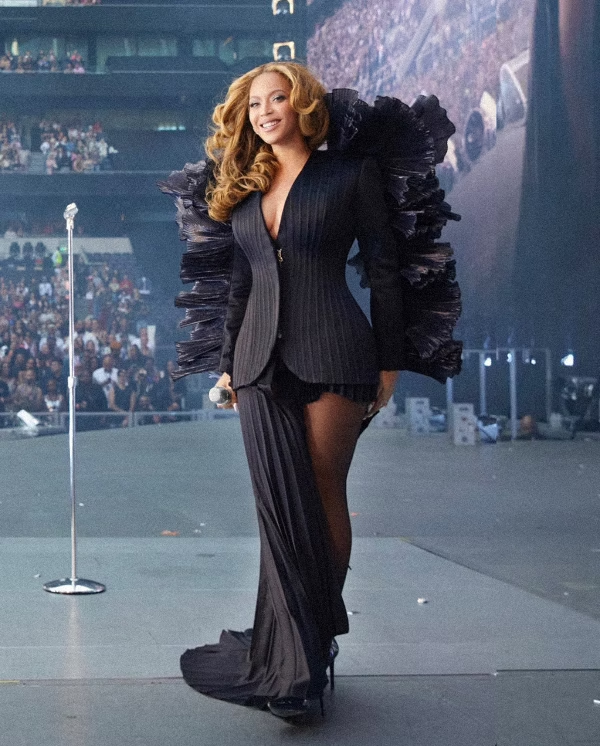
Beyoncé
One of the earliest major supporters of the brand.
Beyoncé's embrace of Wun introduced his work to a global audience and demonstrated how effectively his dramatic silhouettes translated to performance.
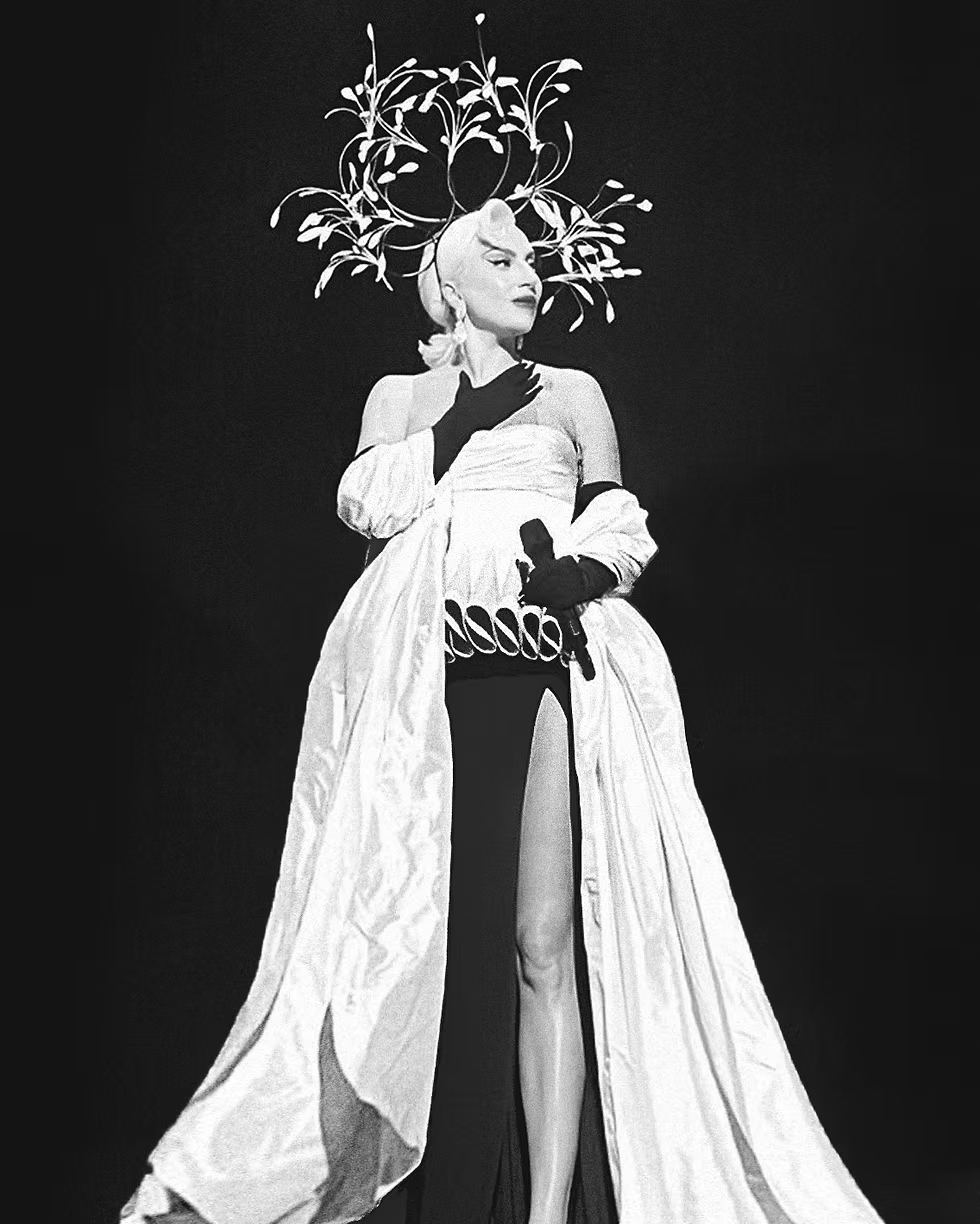
Lady Gaga
Few artists understand fashion as performance better than Gaga.
Her affinity for conceptual design made Robert Wun a natural fit.
Cardi B
Cardi has repeatedly gravitated toward designers capable of creating memorable visual moments.
Wun's sculptural pieces provided exactly that.




Celine Dion
The singer's fashion renaissance brought renewed attention to avant-garde designers, including Robert Wun.
Shania Twain
One of the most widely discussed fashion moments of recent years came when Twain appeared wearing Robert Wun's surreal spotted ensemble, generating significant media attention.
Robert Wun and Lisa: When Couture Meets Global Pop Culture
Among the many celebrities who have embraced Robert Wun's work, Lisa occupies a particularly significant place.
As one of the most influential figures in contemporary fashion, the BLACKPINK star has become a bridge between luxury fashion and a new generation of global consumers. Her appearance in a Robert Wun design at the 2025 Met Gala introduced the designer to millions of people beyond traditional couture circles, transforming what might have remained an insider fashion moment into a worldwide conversation.
The collaboration felt natural. Much like Wun's creations, Lisa's public image is built on transformation, performance and visual storytelling. Rather than relying solely on glamour, the look communicated narrative and character—two elements that have become central to Wun's approach to couture.

For many fashion enthusiasts, Robert Wun was already one of the industry's most exciting emerging designers. For millions of K-pop fans, however, the Met Gala became their first introduction to his work. The moment demonstrated the growing power of Korean pop culture in shaping global fashion conversations and highlighted how designers outside the traditional luxury establishment can achieve worldwide visibility through the right cultural partnership.
In many ways, Lisa's appearance represented exactly what Robert Wun does best: turning a red-carpet look into a story people continue talking about long after the event has ended.
Blood, Shadows and Illusions
One reason Robert Wun stands apart is his willingness to embrace darker emotional territory.
Several collections have incorporated visual references to wounds, shadows, stains and transformation.
Importantly, these elements are never used purely for shock value.
Instead, they function as narrative devices.
A red mark may symbolize memory.
A tear may represent change.
A shadow may suggest dual identity.
This emotional layering gives his work unusual depth.
Fashion becomes metaphor.
Why Editors Love Him
Fashion editors encounter thousands of garments every year.
Very few remain memorable.
Robert Wun's work does.
Not because it is loud.
But because it feels personal.
His collections invite interpretation.
They encourage conversation.
They reward close observation.
In an industry increasingly driven by speed, Wun's work asks viewers to slow down.
That alone feels revolutionary.
The Asian Designers Reshaping Couture
The rise of Robert Wun reflects a broader shift occurring within luxury fashion.
For decades, haute couture remained overwhelmingly European.
Today, designers from across Asia are increasingly shaping its future.
Figures such as Guo Pei, Rahul Mishra and Robert Wun are expanding the language of couture beyond traditional boundaries.
Wun occupies a particularly interesting position within this movement.
His work does not rely heavily on cultural symbolism.
Instead, it communicates through universal emotions.
Fear.
Joy.
Anticipation.
Transformation.
The result is fashion that feels global without losing its individuality.
Legacy in Progress
Most fashion histories are written after a designer's career has ended.
Robert Wun presents a different challenge.
His story is still being written.
Yet even now, certain conclusions seem clear.
He has reintroduced storytelling as a central element of contemporary couture.
He has demonstrated that conceptual fashion can remain emotionally accessible.
And he has proven that independent designers can still carve out space within an increasingly consolidated luxury industry.
The qualities that transformed fashion into an art form in the first place.
And perhaps that is why so many people believe he is not simply one of fashion's rising stars.
He may be one of its future legends.


