%20(1).png)
RUDY GERNREICH: The Designer Who Invented Fashion's Future Before the Future Existed
- 8 jun
- 5 min de lectura
Yet long before conversations about gender fluidity, body positivity, sexual liberation and unisex dressing entered the mainstream, one designer was already exploring them with extraordinary audacity.
His name was Rudy Gernreich.
Today, his legacy is often reduced to a single garment: the infamous topless swimsuit that shocked the world in 1964. But to remember Gernreich solely for the Monokini is to overlook one of the most visionary minds fashion has ever produced.
He was not merely designing clothes.
He was imagining entirely new ways of living.
Decades before fashion embraced androgyny, he questioned gendered dressing. Decades before luxury houses celebrated diversity, he challenged conventional beauty standards. Decades before designers spoke about freedom, he built entire collections around the idea.
In many ways, the twenty-first century finally caught up with Rudy Gernreich.
From Vienna to Los Angeles
Rudolf Gernreich was born in Vienna in 1922 into a Jewish family with deep roots in the garment industry.
Fashion was present from the beginning. His father owned a hosiery manufacturing business, exposing him to clothing production from an early age. Yet his childhood would be shaped less by fashion than by political upheaval.
The rise of Nazism transformed Europe. Following the annexation of Austria by Germany in 1938, life became increasingly dangerous for Jewish families. Gernreich and his mother fled the country, eventually settling in Los Angeles after a difficult journey through Europe.
The experience left a lasting mark.
Many historians believe that Gernreich's lifelong rejection of social conformity emerged directly from witnessing the consequences of rigid ideology and intolerance. Freedom, for him, was never an abstract concept. It was personal.
That belief would later become the foundation of his work.
The Dancer Who Became a Designer
Unlike many fashion designers, Gernreich did not begin by dreaming of couture houses or Parisian salons.
His first great passion was movement.
After arriving in California, he studied modern dance and became involved with choreographer Lester Horton, whose dance company would later influence generations of performers.
The connection between dance and fashion would remain central throughout his career.
Gernreich understood how clothing behaved in motion. He cared less about static elegance and more about how garments interacted with the body.
This perspective distinguished him from many contemporaries who still approached fashion through the lens of traditional couture.
His clothes were designed for living.
For movement.
For modernity.
The Birth of a New Fashion Language
By the late 1950s, American fashion was still heavily influenced by post-war ideals of femininity.
Christian Dior's New Look had established a silhouette built around cinched waists, structured undergarments and highly controlled shapes.
Women were expected to conform to a particular image.
Gernreich wanted none of it.
Instead, he began creating garments that emphasized comfort, simplicity and freedom.
His designs rejected unnecessary decoration.
He favored geometric construction.
Clean lines.
Knitwear.
Stretch fabrics.
Minimal seams.
Architectural silhouettes.
What seems normal today was genuinely radical at the time.
Many of his garments appeared startlingly futuristic because they abandoned references to the past.
Rather than looking backward, Gernreich imagined what people might wear decades later.
Peggy Moffitt: The Face of a Revolution
No discussion of Rudy Gernreich is complete without Peggy Moffitt.
The model became his greatest muse, collaborator and visual ambassador.
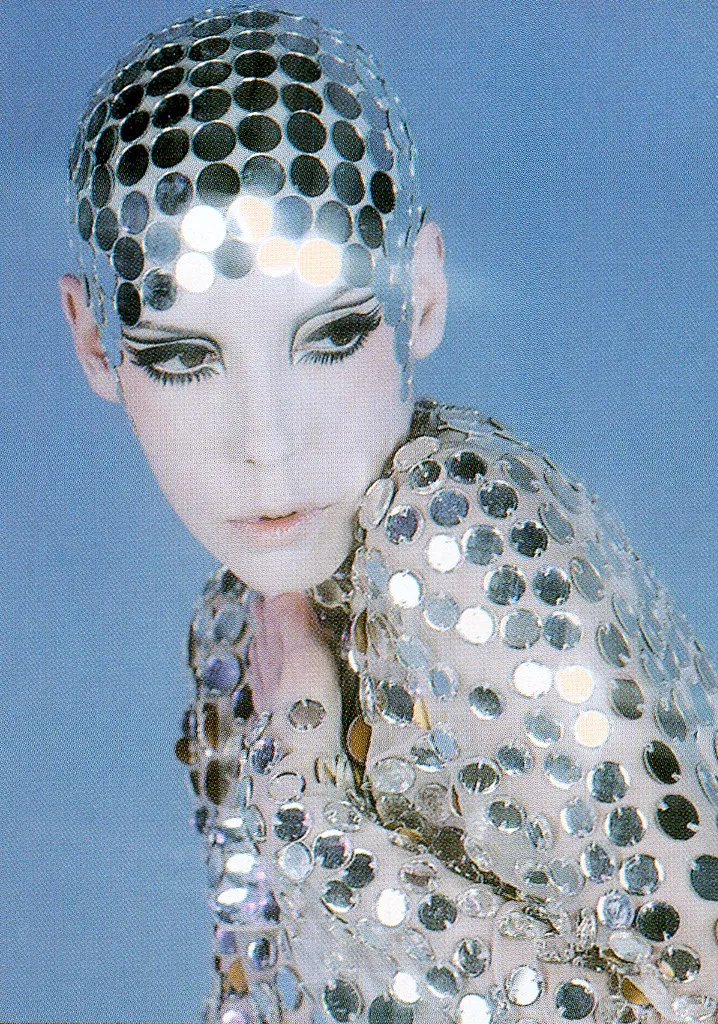
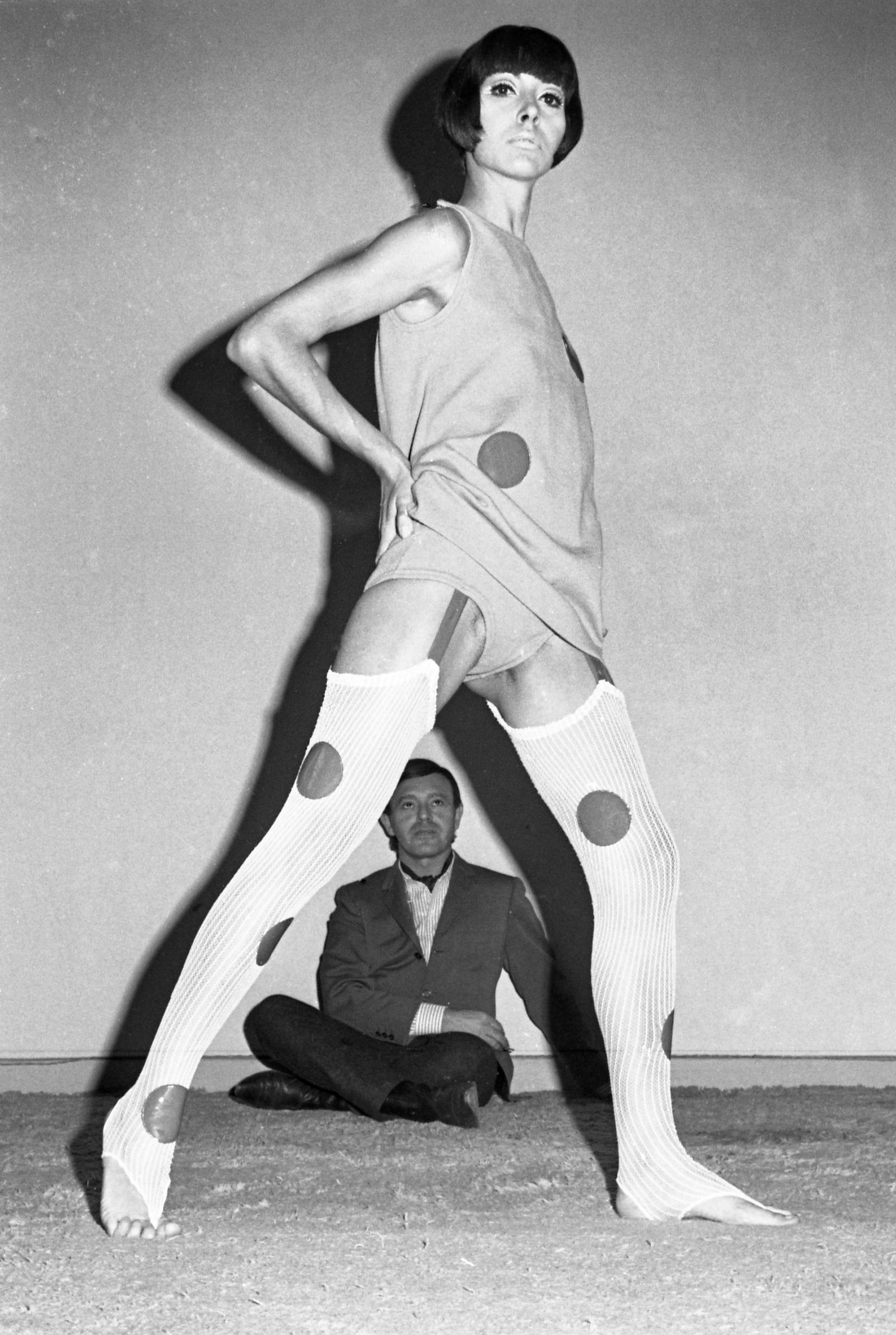
With her graphic Vidal Sassoon haircut, dramatic eye makeup and striking presence, Moffitt embodied everything Gernreich represented.
Together they created some of the most recognizable images in twentieth-century fashion.
Their collaborations transformed fashion photography.
The photographs did not feel romantic.
They did not feel traditionally glamorous.
They felt modern.
Almost alien.
The imagery remains astonishingly contemporary even today.
Many editorial concepts currently celebrated on Instagram and TikTok can trace their visual DNA back to Gernreich and Moffitt's experiments during the 1960s.
The Monokini That Shocked the World
In 1964, Rudy Gernreich designed the garment that would make him internationally famous.
The Monokini.
Technically, it was a swimsuit consisting of a high-waisted bottom connected by thin shoulder straps, leaving the breasts uncovered.
Photographs of the design caused a global media storm.
Newspapers condemned it.
Religious groups protested.
Governments debated it.
Fashion critics argued over it.
The public was scandalized.
Yet the garment was never intended simply as provocation.
Gernreich viewed the Monokini as a political statement about bodily freedom and social hypocrisy.
He understood perfectly that most women would never wear it.
The point was not commercial success.
The point was forcing society to confront its assumptions.
In retrospect, the Monokini became one of fashion's earliest examples of clothing functioning as cultural commentary.
Today, it is considered one of the most influential garments of the twentieth century.
Fashion and Sexual Liberation
The 1960s witnessed profound social change.
Youth culture challenged traditional authority.
Feminism gained momentum.
Attitudes toward sexuality began to evolve.
Few designers reflected these transformations more directly than Gernreich.
Unlike many contemporaries, he did not merely respond to cultural shifts.
He anticipated them.
His collections repeatedly explored themes of liberation, self-expression and personal autonomy.
He believed clothing should empower rather than restrict.
This philosophy influenced every aspect of his work, from fabric choices to silhouette construction.
Fashion was no longer simply about appearance.
It became a tool for social change.
Inventing Unisex Fashion
Today, gender-neutral clothing is a major conversation within luxury fashion.
Brands frequently release collections designed to transcend traditional categories.
Rudy Gernreich was exploring these ideas more than fifty years ago.
Throughout the late 1960s and early 1970s, he created garments deliberately intended for both men and women.
His vision of unisex dressing extended beyond simple aesthetics.
He believed gender distinctions in clothing were largely artificial.
He imagined a future where individuals selected garments based on personal preference rather than social expectation.
The concept was revolutionary.
Many of his predictions now feel remarkably accurate.
When contemporary designers discuss fluidity, they are often revisiting territory Gernreich explored decades earlier.
Beyond the Monokini: Designs That Changed Fashion
The Monokini may have become the headline, but it was only one chapter in a remarkable career.
Among his most influential creations were his seamless knit garments, which challenged conventional tailoring methods.
He popularized body-conscious silhouettes years before they became mainstream.
His use of stretch materials helped redefine how clothing could fit and move.
He introduced bold geometric motifs that became emblematic of 1960s modernism.
His transparent garments challenged notions of modesty and visibility.
Even his swimwear designs beyond the Monokini helped redefine beachwear aesthetics.
Many concepts later adopted by sportswear, contemporary fashion and luxury ready-to-wear can be traced back to innovations Gernreich explored first.


A Quiet Pioneer of LGBTQ+ Visibility
One of the most remarkable aspects of Rudy Gernreich's story remained largely hidden during his lifetime.
He was openly gay within private circles at a time when doing so carried significant personal and professional risks.
He also played a role in the early American LGBTQ+ rights movement, becoming involved with organizations advocating for equality long before such activism entered public discourse.
Although he rarely positioned himself publicly as a political figure, his work consistently challenged traditional assumptions about identity, sexuality and freedom.
Fashion became a language through which these ideas could be explored.
Why Modern Fashion Owes Him More Than It Admits
The influence of Rudy Gernreich can be found almost everywhere in contemporary fashion.
In the body-conscious minimalism of the 1990s.
In the gender-fluid collections of the 2020s.
In the futuristic runways of designers such as Iris van Herpen.
In the experimental silhouettes of Rei Kawakubo.
In the intellectual fashion discourse surrounding identity and self-expression.
Many of the industry's most progressive conversations began with questions Gernreich was already asking decades ago.
His work feels strikingly current because society continues to grapple with the issues he explored.
Freedom.
Identity.
Visibility.
The relationship between the body and clothing.
The right to self-definition.
The End of an Era
Rudy Gernreich passed away in 1985 at the age of sixty-two.
His death marked the end of one of fashion's most intellectually ambitious careers.
Yet his influence never disappeared.
Museums continue to exhibit his work.
Fashion historians continue to reassess his contributions.
Designers continue to draw inspiration from his ideas.
And every time fashion challenges conventions, questions assumptions or imagines a different future, Gernreich's spirit remains present.


